The expanding human eco-footprint is arguably the world’s best-known indicator of the (un)sustainability of techno-industrial society.
The wealthy world “is living off its ecological credit card. While this can be done for a short while, overshoot ultimately leads to liquidation of the planet’s ecological assets, and the depletion of resources, such as the forests, oceans and agricultural land upon which our economy depends.” Mathis Wackernagel, Global Footprint Network.
Heard of a Blue Ocean Event? To summarise: ‘Losing the reflective power of Arctic sea ice will lead to warming equivalent to one trillion tons of CO2 and advance the 2ºC threshold by 25 years.’ This means the ‘equivalent to an increase in CO2 concentration from 400 to 456.7 parts per million.’ A Blue Ocean Event is on its way. Collapse is inevitable, but justice isn’t. A #PlannedCollapse is a #JustCollapse.
More and more, people are talking collapse – with their friends, partners, family and work colleagues. Just Collapse wants to hear about your experience of talking collapse. What is your best experience? What is your worst experience? What have you learnt?
Talking collapse is vital for justice – everyone has the right to know, and a collapse-conscious citizenry can plan for collapse.
Share your thoughts on this post, or send us an email if you would like to share your experiences privately: JustCollapse@outlook.com
There is human and ecological justice to be achieved if we start now to deliberately contract the human enterprise. Collapse is inevitable, but justice isn’t:
‘For me at least, the choice of which path we need to follow is obvious: purposeful contraction of humanity and its complex systems. It needs to be purposeful if we are to have any say in how it proceeds. I am increasingly coming to the conclusion, however, given everything I have discussed above, that the path I advocate will be ‘The Road Not Taken’; at least not until nature forces us upon it and then we won’t have any say in how it unfolds.’ #JustCollapse #RadicalDegrowth
IPCC scientist’s opinion, expressed anonymously, contrast significantly with public statements made by celebrity climate commentators, news media pundits, and various ‘talking heads’ (according to survey – Nature). Disingenuously, Mann continues to promote the idea that 1.5 is still alive, despite the fact that almost everyone, who follows the science, knows that 1.5 has already been passed and is merely hidden by the aerosol masking effect. Celebrity science communicators who publicly, and intentionally, obscure the truth from the public, deserve a special reservation in the hell that is to come. Seek justice! Take action! #TalkCollapse
Chemical warfare is being waged against our biosphere. ‘Chemical pollution threatens Earth’s systems by damaging the biological and physical processes that underpin all life. “There has been a fiftyfold increase in the production of chemicals since 1950… The pace that societies are producing and releasing new chemicals into the environment is not consistent with staying within a safe operating space for humanity”.’
Because of #overshoot, five out of nine planetary boundaries have been crossed. Chemical pollution represents the 5th boundary crossed, the others being, the destruction of wild habitats, loss of biodiversity, climate change, and excessive nitrogen and phosphorus pollution. Collapse is inevitable. Justice isn’t. #JustCollapse
We have passed #PeakCivilisation. After the Great Acceleration, comes the Great Descent. Civilisations have come and gone before, but the scale of modern techno-industrial civilisation makes this collapse unprecedented. Escalating global food and fuel prices are but one precursor of inevitable global collapse.
We must seek justice where and when we can; fighting for justice on the way down. A #PlannedCollapse is a #JustCollapse.
Global food systems are at breaking point and global food prices are at a record high (Smith 2022; UNFAO 2021).
In marking International Women’s Day, we acknowledge that women, among others disadvantaged, marginalised and dispossessed, bear the brunt of food scarcity especially in countries least responsible for the severity of this predicament: ‘Most African nations are net food importers, meaning that any increases in global food prices have a significant effect on the continent’s 1.4 billion people, the majority of whom spend up to 60% of their income on imported staples such as rice, corn and pasta. Over the past two decades, more Africans have become heavily dependent on imported food… leaving them vulnerable to the rising cost of shipping food globally.’
Planning: ‘the process of identifying actions required to achieve an outcome’
Collapse: ‘the fall of a socio-ecological system characterized by the loss of complexity, structure and order’
‘Planning’ and ‘collapse’ are not normally two words that would work together. In these unprecedented times, we explain not only how they do work together but how, in combination, they redefine the parameters of political struggle and activism, and how people can begin work for a planned collapse.
Developed during a period of history marked by the ideal of progress, planning now faces a crisis. We have been in overshoot for 50 years. Driven largely by wealthy nations, we are using and consuming more, through extraction, production, land clearing and industrial agriculture, than the planet can replenish each year. At the same time, we are emitting, wasting, and polluting more than the planet can effectively process. Overshoot thereby diminishes the productive capacity, and the carrying capacity, of our biosphere.
Earth’s climate and ecological systems are collapsing, and as they go, so too, inevitably, does global modern techno-industrial civilization. While some might proclaim this inevitability, ‘good news’, the reality is that life on earth will not benefit from this eventuality.
Global modern techno-industrial civilisation is dependent on fossil fuels, enabling eight billion people to inhabit the earth. If fossil fuel use stops, there is no viable, alternative way of feeding so many. Perversely, atmospheric pollution from fossil fuel use also protects us from some global warming. Removing these pollutants would result in a rise in global temperature. We collapse if we continue using fossil fuels. We collapse if we don’t.
Understanding the inevitability of collapse demands that instead of planning on the up, we must learn to plan on the down.
Planning rules and regulations are, for many people, their only experience of planning. Planning is also about setting agendas and identifying actions to meet these agendas. Industrialization and market-based economies do not, intuitively, create habitable places. Despite the ‘invisible hand of the market,’ over one billion people live in slums or informal settlements, while others are homeless and seeking refuge. Production and consumption not only can cause harm to immediate environments but can also export negative impacts to other places. In response to the uninhabitable places created by global industrial civilisation, modern western planning sets agendas for developing places that are more liveable, sustainable, and/or profitable.
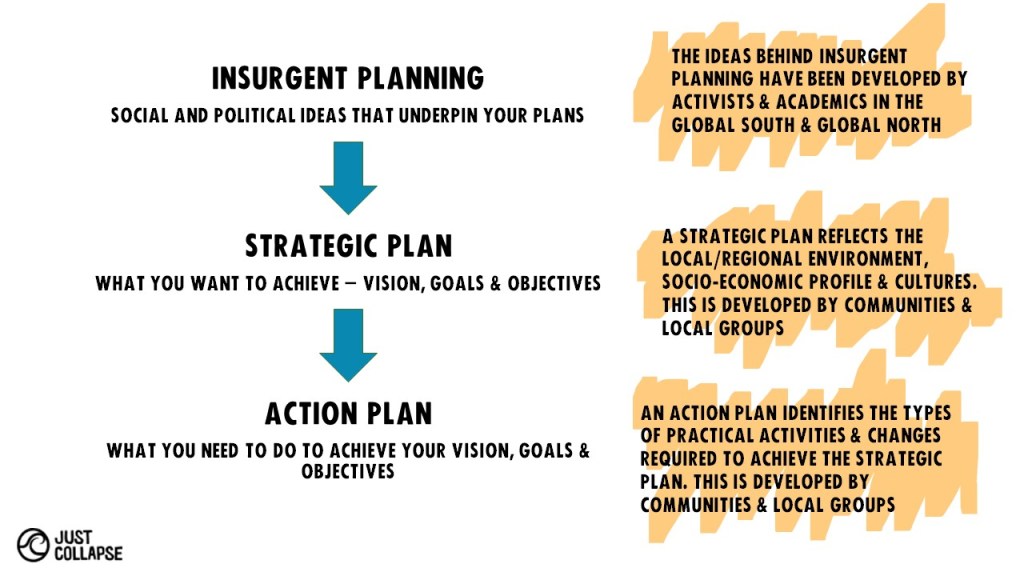
Insurgent Planning is a form of planning that occurs when governments break the social contract and fail to act in the public good. Developed by activists and academics, particularly in the Global South, insurgent planning turns modern western planning on its head. Typically, professional planners identify and set agendas on behalf of government. Conversely, insurgent planning does not rely on governments for decision-making and action. Instead, communities and citizens exert and extend power by setting their own agendas and implementing their own actions. They do not wait for elected representatives, or other powerbrokers, to act on their behalf. They act outside of formal processes and structures to achieve more equitable outcomes. By nature, insurgent planning is not sanctioned by government.
For example, in South Africa, the Western Cape Anti-Eviction Campaign resisted forced eviction of informal communities along a highway that linked Cape Town’s international airport to the city. Comprised of residents and organisers from poor townships, this Campaign demanded rights to shelter and basic services. Actions included,
‘…informal negotiations with the agents of forced eviction to ignore or postpone its implementation, …capacity building and creating their own data about the plight of evicted or threatened families, …operating weekly soup kitchens to feed children, …defiant collective actions such as reconnection of disconnected services by so-called ‘struggle plumbers and electricians’ and relocation of evicted families back into their housing units, …mass mobilizations and protests, sit-ins, and land invasions – as well as the use of courts and legal claims’ (Miraftab, 2009).
Climate action and environmentalism tend to be based on a gross misconception – that government is, invariably, the central decision-maker. Because of this, green agendas have evolved to align with the agendas of government, namely by adopting an ‘infinite growth on a finite planet’ mentality – be this ‘green’ growth or ‘sustainable’ growth. As collapse does not ‘fit’ within a growth paradigm, collapse is not – cannot – be part of these agendas. Insurgent planning, however, can accommodate collapse because communities and citizens set their own agendas and act irrespective of government and other established power structures.
Through insurgent planning, governments still have a role to play, but this role is defined by the agenda of insurgent communities and citizens, not the other way round. Communities, for example, may be able to locally plan and act for food security. Larger scale issues, however, will likely need to be acted on by government, such as the decommissioning of nuclear power plants – these pose a toxic risk following societal collapse and decommissioning requires significant technical expertise and resources.
By failing to act decisively on the climate/ecological crisis, governments and other powerbrokers, have violated the social contract. This means, as part of an insurgent planning agenda, they can also be held to account for their inaction.
Setting an insurgent agenda can take some time. It starts with a community or group working to establish a shared vision, goals and objectives, as part of a strategic plan. The Western Cape Anti-Eviction Campaign, for example, shared a vision of access for all to shelter and basic services. To meet these shared objectives, actions are then identified. In Cape Town, this included disruptive actions, as well as utilising existing structures such as the legal system.
As collapse unfolds, plans and actions will need to adapt and change. The reality is that what makes sense today may not make sense in the future. Importantly, insurgent planning within collapse comes with a sober appreciation that, in the end, there will be no ‘win’. After 50 years of overshoot, no amount of human agency can turn collapse around, and we can only do what we can do. In understanding that although death will surely come for us all, today is not that day, and there is plenty yet to fight for on the way down.
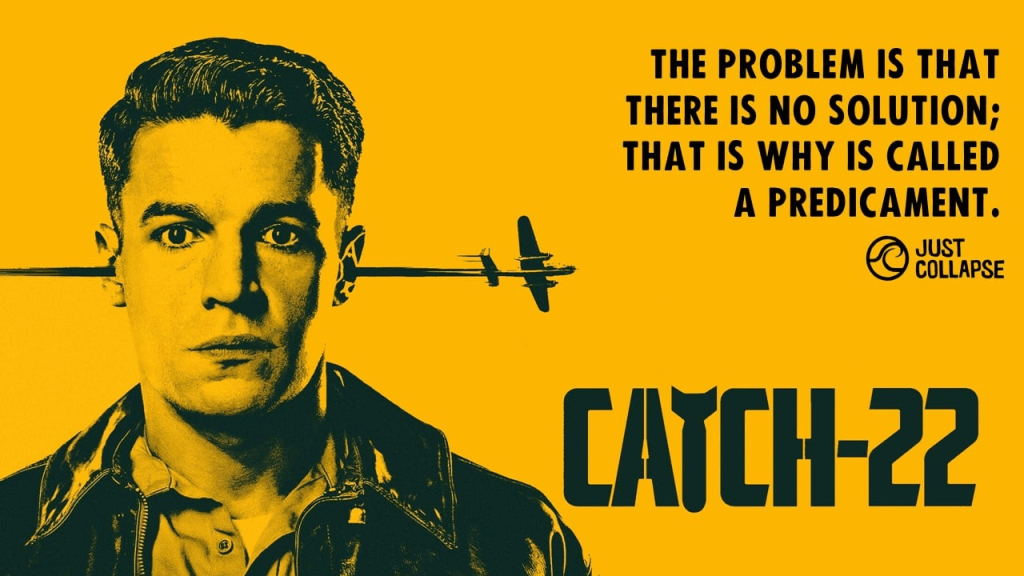
We are damned if we do. We are damned if we don’t.
Stopping fossil fuels will collapse us. Not stopping fossil fuels will collapse us. Global civilisation is fossil fueled.
Not understanding this predicament leads to maladaptive planning and action. For example, action calling for an end to fossil fuels without talking about collapse leads nowhere.