What is mutual aid?

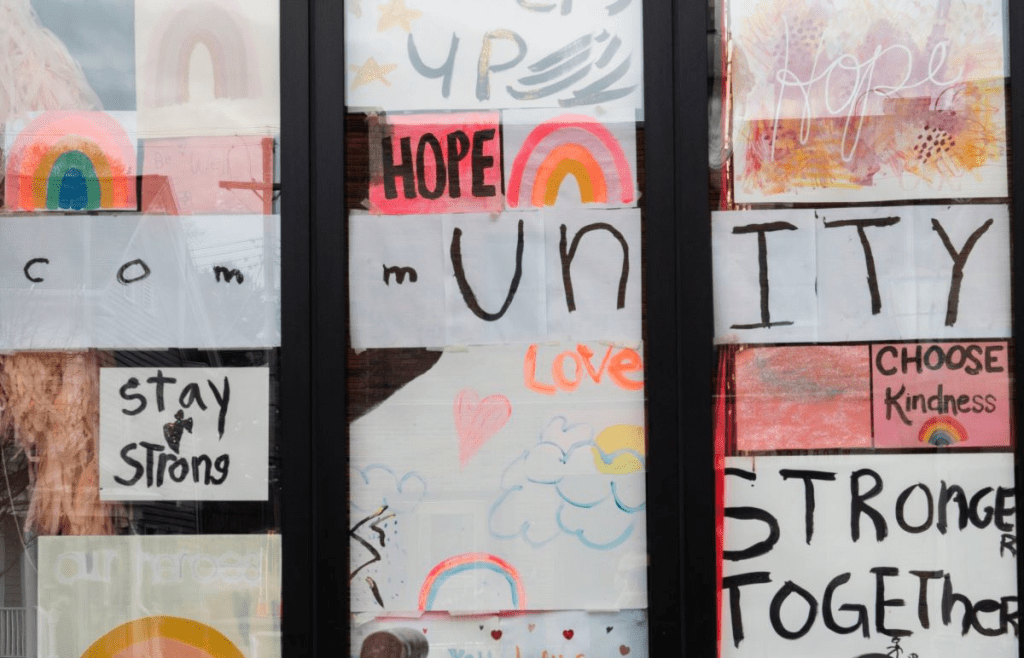
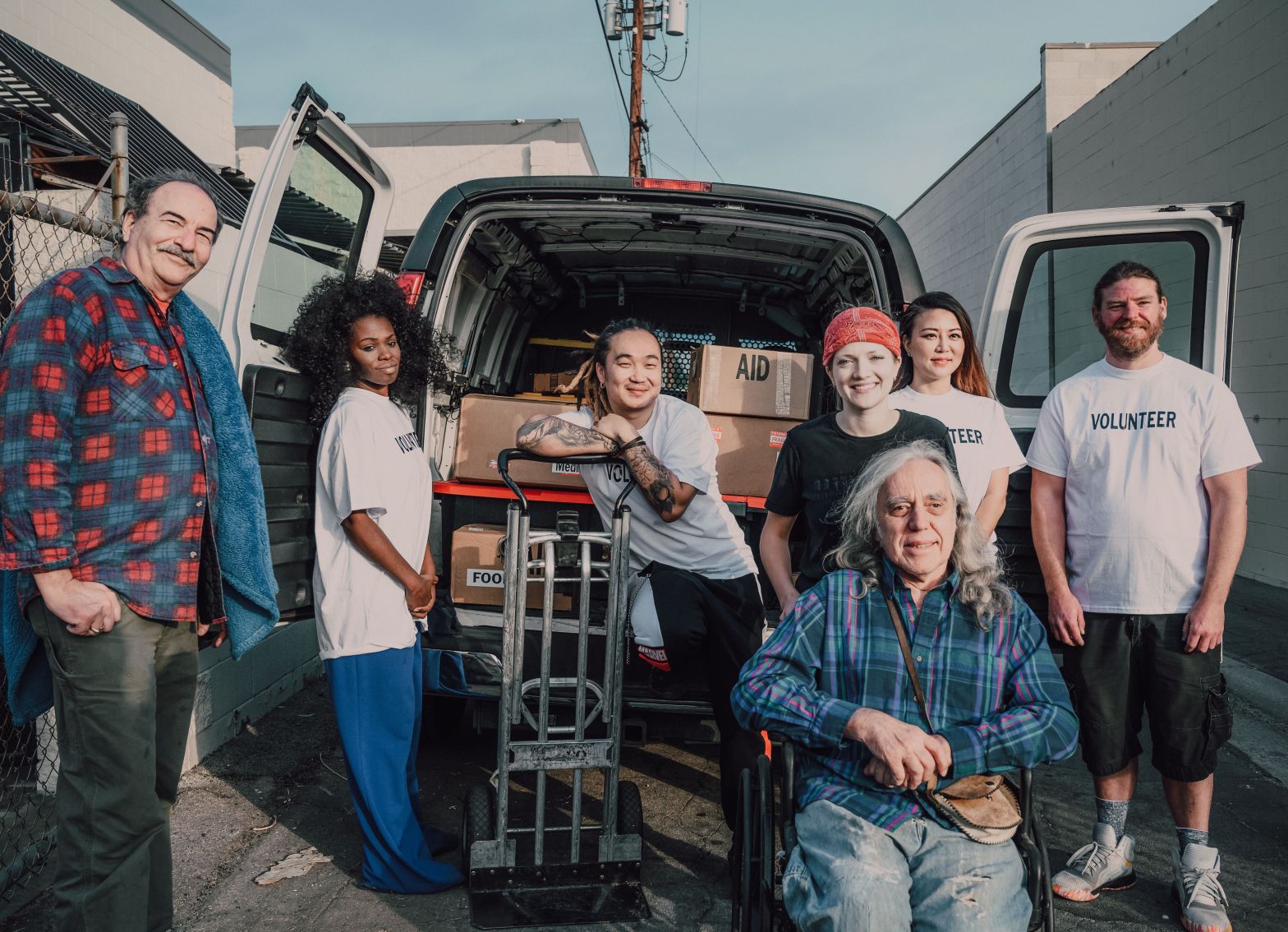
Mutual Aid is an essential part of a Just Collapse. In addressing inequity and inequality, mutual aid can help house and feed people, build a sense of belonging and solidarity, and contribute to networks and movements standing against the far right and other forms of oppression. Article by Abby Lee Hood:

“After the tornado, I accepted my first food handout from neighbors. I spent hours alongside strangers picking up debris and insulation, using tools lent by people standing on street corners, and eating food they brought us. I’d never experienced such a coming together.

As we faced what seemed like endless struggles for our neighborhood, we’ve continued to volunteer, clean up disaster areas, feed and care for each other …

These experiences taught me the value of mutual aid, and I wondered: How do we continue this momentum and make it permanent? What can other communities do to implement mutual aid in their regions?”

Can we go green again?

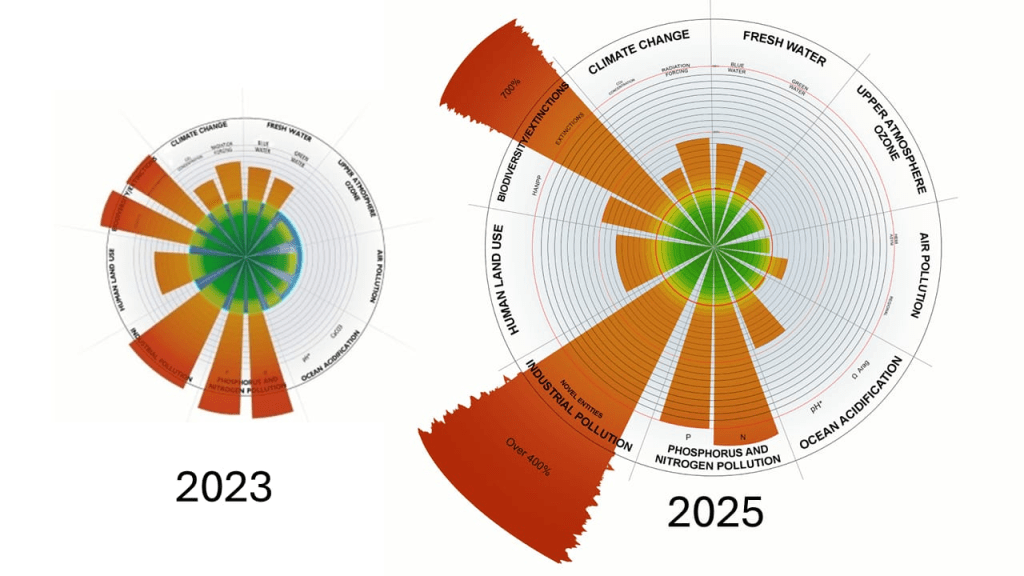
Many who are aware of unfolding and irreversible collapse are familiar with the planetary boundary diagram. Updated periodically by the Stockholm Resilience Centre, the green center at the heart of the diagram is our ‘safe operating zone’. The spectrum of yellow, red, and purple signify how the boundaries of this zone are being transgressed, contributing to an unsafe biosphere and a loss of habitable Earth. These transgressions are not a projection: these are depictions of real-time biosphere degradation based on a synthesis of a huge body of scientific research.

Yet, this diagram can be deceptive. Because despite transgressing around eight of the nine boundaries, the ‘safe operating zone’ is depicted as intact. The diagram appears to show that this zone still exists and that is still possible to return to a secure and stable world. A better, brighter future is possible!

In reality, we now inhabit a world of yellow, orange, and red, with only a tinge of green remaining. There is no safe center to return to. Many are already aware of this as they live in places that are dangerous, toxic, lacking basic resources like food and water, and subject to climate extremes like heatwaves and floods. These people and communities tend to be in poorer places – places already collapsed through processes like colonialism and capitalism.

This is why a politics of collapse is about socio-ecological justice – acting now for a Just Collapse!

More information on the planetary boundaries and acting for a Just Collapse.

“I’m scared”: the conversation nobody wants to have


Excerpt from Tadzio Mueller’s forthcoming book:

I’m scared of the future.

It wasn’t always like this, because despite being a “commie eco faggot”, I am, first and foremost, a fairly privileged, bourgeois (albeit half-migrant, but white-passing) cis man, and as such the world didn’t, until recently, really have to frighten me. Until not so very long ago, until the end of the last decade, I was certain, on some deep psychological level — “knew,” in a way that was probably more faith than actual knowledge — that the future would be good, or at least: could be good. What exactly “good” meant, whether it was about “fully automated luxury communism” or global climate justice or “the good life for everyone” or simply “a good life and a pleasant old age for my husband and me,” wasn’t really the point; in any case, I was convinced that a “good” future for everyone in the world was possible.

But “the movements” didn’t win: the final battle never came, and the many second-, third- and fourth-to-last battles that are currently under way don’t look particularly good for the progressive side — the left, the greens, the remaining humanist centre. And instead of moving, a bit jerkily, two steps forward, one step back, towards a good, enlightened, liberated world for everyone, we’re moving in great strides towards something nobody really wants to think about. Towards collapse.

Read more on Tadzio’s blog.

New article: Just Collapse and post-anarchism

If irreversible collapse changes politics and activism, what do we call this politics? In this new article, A/Prof Kate Booth looks at ‘post-anarchism’ as a way of articulating and acting for socio-ecological justice in decline and disaster:

“… post-anarchism is about living between worlds– between the dying, collapsing world of global capital and climate-ecological destruction and the unknown future worlds of disparate people and places created as collapse intensifies and unfolds. Many find themselves inhabiting two worlds at once – in one world oppressed by capitalism and imperialism and in another world sustained (even if marginally) by the very same processes.”

The full article is published in the first volume of the Lutruwita Activist and Mutual Aid journal. All proceeds go towards establishing a social centre in nipaluna/Hobart, Australia.

Upcoming event – Germany

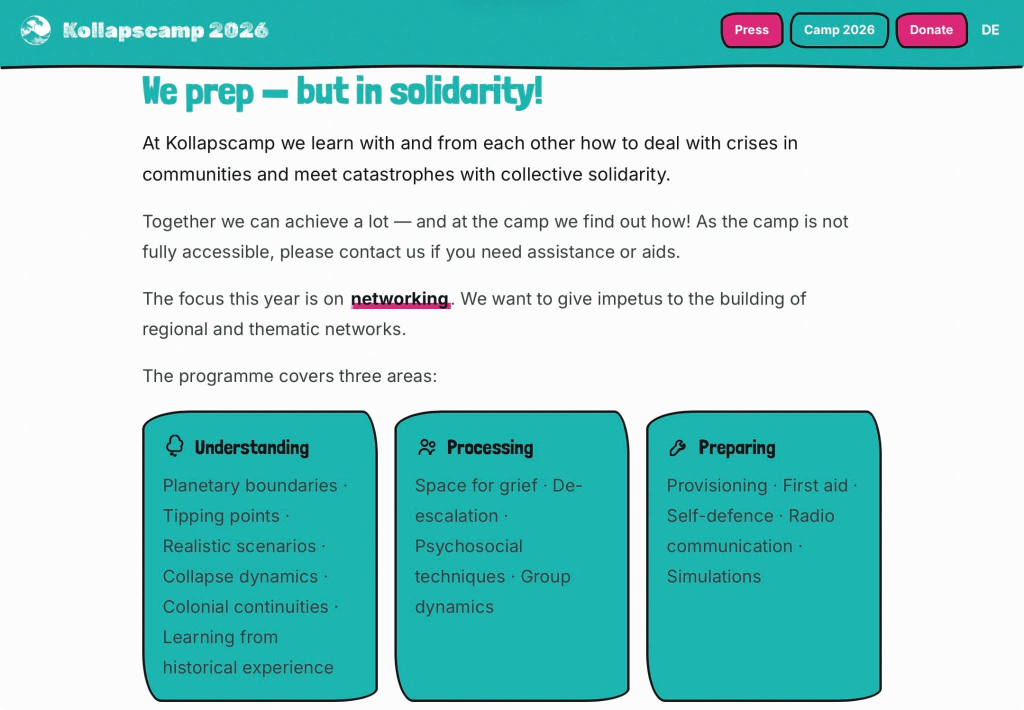
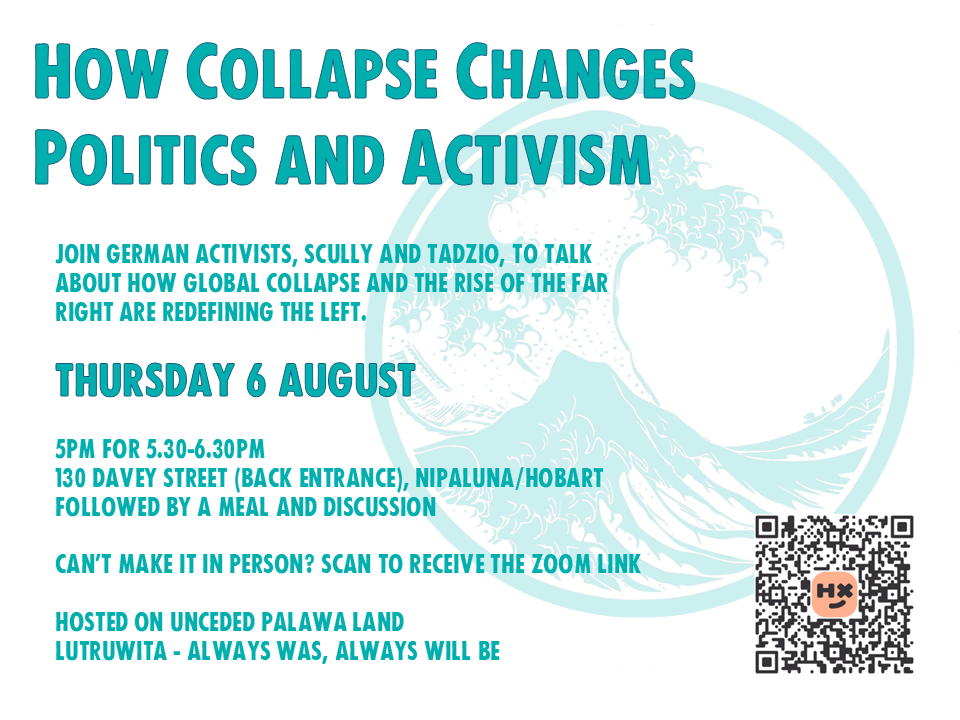
Mutual Aid HEAT is an upcoming week-long event, practicing mutual aid in stressful situations. This kind of event is collapse activism – the new frontier of leftwing politics. Why? Because collapse changes politics and activism, and we must do what we can for each other and to resist the rise of the right.

“We are planning an event for those who take the threat of collapse and authoritarianism as seriously as we do; who know that we must prepare now—not just in a few years—for climate disasters, authoritarian takeovers, systemic breakdowns, and reduced state support; and who know that preparing for a future marked by increasing disasters means investing time and resources in those preparations now.”

“However, solidarity-based structures don’t just mean looking out for one another—that is, building mutual aid groups. They also mean driving political activism, challenging existing structures of power and domination, and organizing. Queer people, people with immigrant backgrounds, and many others are particularly at risk of being actively attacked or neglected by others. We make this interplay tangible and teachable so that we can remain capable of acting in solidarity and as activists in the long term.”

Just Collapse is back!

Just Collapse is back with a revitalised website!

As a platform dedicated to socio-ecological justice in unfolding and irreversible global collapse, Just Collapse matters more than ever – because collapse is inevitable, but justice is not!

Just Collapse has been through several iterations. The current articulation of a just collapse follows the passing of co-founder Tristan Sykes in early 2026. Tristan’s legacy remains as you will see when you scroll back through the webpages.

Check out the updated homepage, initiatives, and resources page!

In Collapse – new book out now

Available at: In Collapse: When Insurance and Climate Collide | Springer Nature Link

Preface – by Associate Prof Kate Booth

I read Jared Diamond’s Collapse (2005) in my 30s. I couldn’t finish it; it gave me nightmares. I knew, instinctively, that collapse was where the world was heading if things didn’t change significantly. I would reassure myself that if such a terminal event were to occur, it wouldn’t be in the next ten years (yes, future tense and inured by privilege). So until that time I would carry on—with life and social and environmental activism of one kind or another.

By the end of the 2010s, that reassuring imaginary no longer worked for me. Climate change was no longer a distant warning, but a real-time eventuality and the climate movement appeared to fail before it even really got started. Extraction, production, and consumption continued at pace, fuelling the ridiculous aspirations of economic growth. At the end of the decade, the Covid-19 pandemic confirmed doubts that the kind of change I had contributed to could shift the horrendous realities of an unequal, inequitable, and vulnerable world.

In 2021, I co-founded Just Collapse—an activist platform dedicated to socio-ecological justice in unfolding, irreversible global collapse. Understanding collapse as an uneven and inherently unjust process, we began thinking through how decline and breakdown changed politics and activism. If we couldn’t make the promises upon which so much progressive change is premised—a better, brighter future of one kind or another—then what could meaningfully be offered and pursued in the name of justice and equity?

We never expected to be popular. I am pleasantly surprised, however, to now be part of a global network of people and organisations acting for justice in temporally and spatially variegated processes of decline and breakdown. This loose alliance includes people working on mutual aid in the United States, protesting forest destruction in the forests of Europe, protecting pride parades from Nazis in Germany, and regenerating agriculture in parts of Africa.

It’s taken a few years for my academic research to catch up with my activism. I spent a decade researching insurance in a changing climate. This is a topic that reveals the inequities in the promises made by those in the insurance sector; the embeddedness of private insurance in global capital and finance; and questions about how insurance co-constitutes and exacerbates patterns of social inclusion and exclusion. Insurance is now spoken about in terms of collapse—of a catastrophic uninsurable future—although that imaginary is rarely discussed in terms of justice and equity.

This essay-style book is my first long-form foray into collapse research and the emerging field of critical collapse studies—introduced below. The term ‘collapse’ works for me, so this book is not an attempt to justify its use. Nor am I attempting to prove global collapse—if you’re up for doomscrolling, there is more than enough to keep you occupied until the end of time!

Instead, in this book, I explore and interrogate the notion of collapse—a set of ideas that has received surprisingly little attention in the social sciences and human geography. Insurance is insightful in this regard. A key safety net in modern life purportedly at risk of collapse, insurance reveals a lot about how we make sense of the world and about the practices of everyday life. How insurance is organised in a society speaks of what we imagine such society to be, our place within it, and our relationships with others. That organisation speaks volumes about our expectations of government, government expectations of us as citizens, and the role of the private sector and capital in public life. The makeup of insurance reflects what we value and how we value it.

As climate change kicks into overdrive, and inequality and inequity rise, insurance offers an empirical grounding for complex, contested, and periodically dramatised ideas about the end of the world. Because, unlike popularist claims and conclusions infused with toxic positivity, we ain’t got this. Yet, we are unclear what it is ‘we’ haven’t ‘got’, and uncertain what it means to lose both confidence in and agency for progressive socio-ecological change and a better world.

My motivation is to provoke language and ideas that are left leaning, but not in denial of our global trajectory. We need words and stories describing what is bothering us, in all our diversity, in the present and about the future. There is need for language and ideas that support meaningful and just responses to unfolding uneven impacts and hardship. In a nutshell, through the lens of insurance, I lay a path that leads to where many are already at—salvaging solidaristic discourses and practices from the relational wreckage of worlds in collapse.

Can you help

You know the world’s f…….ed when you can’t afford to die!

Tristan Sykes was a collapse activist, one of a handful of people who defined this style of thought and action. He would routinely share Just Collapse posts across up to 100 Facebook pages (when FB would allow!) and made connections, friends and, occasionally, adversaries around the world. If you are one of the people influenced by Tristan’s work, please support his family in covering cremation and memorial costs by sharing this post to pages you follow. Standing in solidarity in collapse!

https://gofund.me/895cffdfa

This is the one and only time Just Collapse will solicit funds.

RIP Tristan Sykes

With immense sadness, I share the news of Tristan Sykes’ passing – unexpected and sudden. Tristan was my best friend, lover, and activist-in-arms for many years. His intelligence, wit, and strategic nouse were key to the success of Just Collapse. He spent his life fighting injustice and standing with the oppressed and marginalised. The world is a darker place without him. – Kate Booth, Just Collapse co-founder