Relying on philanthropy and innovations of billionaires to save us from global collapse? Think again: ‘Their extreme wealth and privilege served only to make them obsessed with insulating themselves from the very real and present danger of climate change, rising sea levels, mass migrations, global pandemics, nativist panic and resource depletion. For them, the future of technology is about only one thing: escape from the rest of us.’ READ MORE
Socio-ecological justice can only be served through a #PlannedCollapse that redistributes power to the marginalised, disadvantaged, and dispossessed.
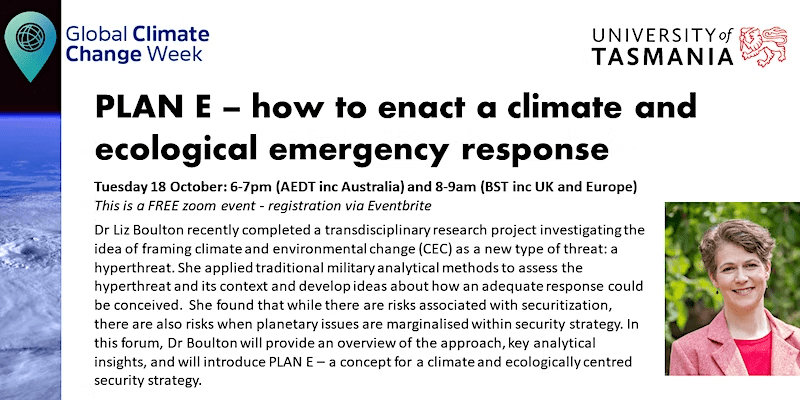
How do we plan for navigating climate and ecological catastrophe? In this forum, Dr Elizabeth Boulton describes the ‘hyperthreat’ that is our predicament, how to plan to meet the challenges unfolding through this threat, and how censorship is being used to control alternative security narratives.
A #PlannedCollapse is a #JustCollapse; any security narrative must entail a redistribution of power to the marginalised, disadvantaged, and dispossessed.
‘…societal collapse on a global scale is inevitable… there’s no averting this collapse – electric cars aren’t going to save us, and neither are global climate accords. The current way of things is doomed, and it’s up to us to prepare as best we can to ensure as soft a landing as possible when the inevitable apocalypse arrives’. Read more in The Guardian.
Starvation, dehydration, disasters, disease, war – collapse is inevitable, but socio-ecological justice isn’t. For the marginalised, disadvantaged and dispossessed a #PlannedCollapse is a #JustCollapse.
Global ecological #overshoot is leading to a confluence of crises. Climate, economy, food, energy, politics – these are the many faces of #collapse, and Pakistan is currently experiencing all of them: “With millions of acres of farmland still under water and certain roads inaccessible, [food] prices are expected to climb further.” Read more.
Collapse is coming for us all – there are no exceptions. Seek justice and take action for a #JustCollapse.
The virtual economy has real world consequences. This is the reality of infinite growth on a finite planet. Whichever way you slice it, collapse is inevitable: ‘Information might seem immaterial. But within a few short centuries, the total amount of digital bits produced annually by humanity could exceed the number of atoms on our planet and, even more unexpectedly, account for half of its mass. Those are the conclusions of a mind-bending new study looking at the growth of data over time and its potentially catastrophic consequences.’ A #PlannedCollapse is a #JustCollapse.
Planning for collapse requires deep engagement with what collapse entails. It’s a lot easier, as climate appeasers do, to think only about the possibility of stopping collapse – of preventing the impossible. But we are currently tracking on the worst-case scenario and as Prof Bill McGuire describes, quoting the conclusions of a recent scientific paper: ‘…“climate endgame” scenarios – including societal collapse and the extinction of humankind – have so far been “dangerously unexplored” … there is only one sensible way forward: to hope for the best, while preparing for the worst’. A #PlannedCollapse is a #JustCollapse.
‘What I say today everybody will say tomorrow, though they will not remember who put it into their heads. Indeed they will be right for I never remember who puts things into my head : it is the Zeitgeist‘ George Bernard Shaw
The word ‘zeitgeist’, originating with philosopher Hegel, is the descriptor for the spirit of a time. In 2019, a zeitgeist coalesced around the urgent need for climate action, and climate change became an acceptable and predominant point of conversation. There were many influencing factors – Greta Thunberg, Extinction Rebellion, international convention upon international convention, science upon science – but no singular reason for why, in 2019, just about everyone started talking climate. Unconsciously and sub-consciously, this zeitgeist had taken shape through liminal osmosis.
This same zeitgeist now propels big business and governments into ‘climate action’. With support from large sections of the climate-environment movement, techno-fixes that boost GDP and aim to maintain business as usual, are being rolled out under the guise of a ‘renewables’ transition. This ‘spirit of our times’ is a fraught fusion of progress and climate action, failing to recognise that one is the cause for the other.
Zeitgeists, by nature, are ethereal, multifarious, and ill-disciplined creatures, not easily tamed, nor dominated. The current ‘climate action’ zeitgeist, and its fractured nature, is not a fait accompli, but a malleable phenomenon prone to influence and change. As ‘progress’ cannot be sustained and ‘green hyper-growth’ will only destroy the Earth faster than business as usual, the spirt of our times is amenable to shifting – to becoming one less fanciful, and more closely matching reality.
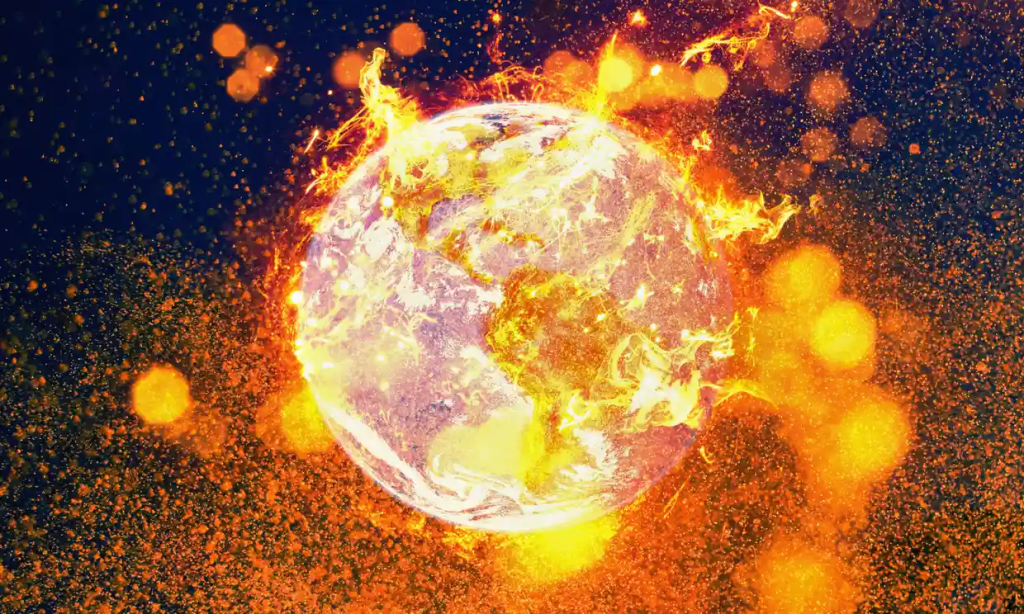
Current zeitgeists now defining the beginning of the 21st century are in hot contention, not least because the era of progress has ended, and the #GreatDescent, well and truly begun. Having thoroughly explored and exploited all opportunities to maintain infinite growth on a finite planet, writing this in August 2022, we now bear witness to 50+ years of ecological overshoot – devastated ecosystems, mass extinction, and an irreparably transformed climate.
As a result, ‘collapse’ is becoming a central emerging aspect of 21st zeitgeist formation and, subliminally, is beginning to seep into every nook and cranny of western culture and society. For it is collapse, not progress, that is defining the spirit of our times and ‘riding’ this emerging zeitgeist a most powerful means of effecting change.
Zeitgeist change is a departure from the theory of change developed by Prof. Chenoweth and colleagues which has informed recent strategies of some climate activism and activist groups. Chenoweth’s theory is based on analysis of 20th century political movements which effected change through non-violent action and weight of numbers – mass mobilisation triggered by the dedication and sacrifice of a few. By employing tactics that were successful in the 20th century, this theory pushes against, rather than works with 21st century zeitgeists, and is thus prone to failure.
As Chenoweth and colleagues identify, this century has seen a solidification of non-democratic intent including increased surveillance and prohibitive protest laws. Chenoweth and colleagues acknowledge, this is not the same context within which successful political activities took place in the 20th century and thus poses significant additional challenges for those pursuing mass mobilisation through non-violent action, as also, does collapse – an eventuality that derails those positive narratives of a ‘happy ending’ that had previously motivated citizens.
In order to effect change, that effort must be located in, and relevant to the spirit of its time. It’s about working with the zeitgeist to shift the zeitgeist. Our situation properly understood is not a simple problem to be solved, but a complex predicament to be responded to. This proper understanding provides the appropriate context and basis for action in face of collapse. What then is appropriate action and how can it be effected? Most importantly, what is to be achieved when things, inevitably, will not end well?
As 21st century zeitgeists form and are increasingly infused with collapse, we are ‘riding this zeitgeist’ by adding notions of Insurgent Planning and socio-ecological justice into the mix. The #TalkCollapse campaign is key here. Working with the reality of collapse, not against – this campaign does not seek to push against the inevitability of collapse nor against planetary limits as the ‘renewables’ transition does. Instead, #TalkCollapse works to make use of the ideal of justice to re-envision what can yet be achieved in a collapsing world.
Now, with more and more people talking collapse, we are collectively changing the shape, character, and direction of the spirit of our times. Doing so ensures a basis upon which we will achieve as much socio-ecological justice as possible within the complex realities and horrors that collapse entails – working together for a Just Collapse.
A ‘renewables’ transition? “Their cost is environmental destruction, the theft of land from villagers and the funneling of money to brutal militias, including at least one linked to Myanmar’s secretive military government. As demand soars for rare earths along with green energy, the abuses are likely to grow.” Read more
The renewable energy industry serves to maintain and support the same power structures and business-as-usual system that has led to our predicament – extinction, extraction, exploitation, colonisation, and war. Don’t be deceived. The system isn’t being changed. It’s a con. #BrightGreenLies
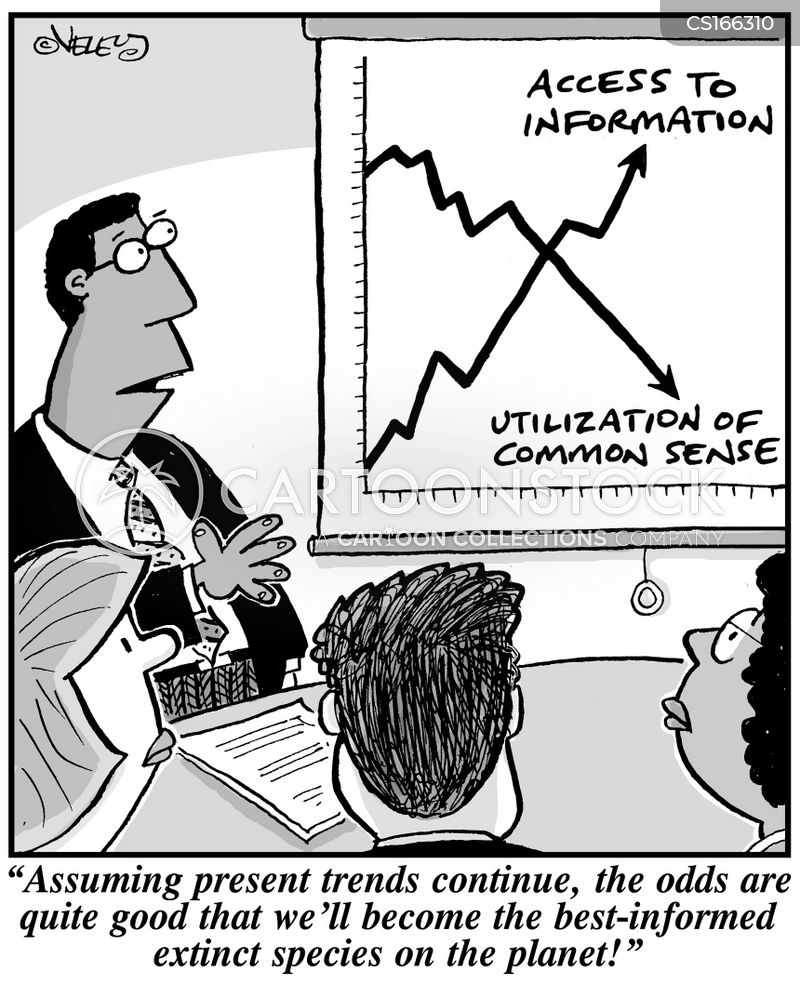
Many have access to immense amounts of information yet refuse to see the truth, instead placing their faith in fairy tales of infinite growth. #TalkCollapse – end the fairy tales, build a collapse-conscious citizenry and act for socio-ecological justice. #JustCollapse
“Our civilization’s collapse will be unique in size, magnified by the destructive force of our fossil fuel-driven industrial society. But it will replicate the familiar patterns of collapse that toppled civilizations of the past. The difference will be in scale, and this time there will be no exit.”