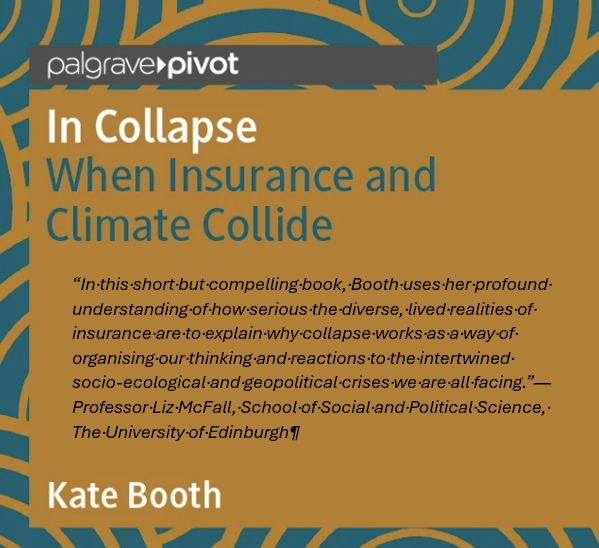
Available at: In Collapse: When Insurance and Climate Collide | Springer Nature Link
Preface – by Associate Prof Kate Booth
I read Jared Diamond’s Collapse (2005) in my 30s. I couldn’t finish it; it gave me nightmares. I knew, instinctively, that collapse was where the world was heading if things didn’t change significantly. I would reassure myself that if such a terminal event were to occur, it wouldn’t be in the next ten years (yes, future tense and inured by privilege). So until that time I would carry on—with life and social and environmental activism of one kind or another.
By the end of the 2010s, that reassuring imaginary no longer worked for me. Climate change was no longer a distant warning, but a real-time eventuality and the climate movement appeared to fail before it even really got started. Extraction, production, and consumption continued at pace, fuelling the ridiculous aspirations of economic growth. At the end of the decade, the Covid-19 pandemic confirmed doubts that the kind of change I had contributed to could shift the horrendous realities of an unequal, inequitable, and vulnerable world.
In 2021, I co-founded Just Collapse—an activist platform dedicated to socio-ecological justice in unfolding, irreversible global collapse. Understanding collapse as an uneven and inherently unjust process, we began thinking through how decline and breakdown changed politics and activism. If we couldn’t make the promises upon which so much progressive change is premised—a better, brighter future of one kind or another—then what could meaningfully be offered and pursued in the name of justice and equity?
We never expected to be popular. I am pleasantly surprised, however, to now be part of a global network of people and organisations acting for justice in temporally and spatially variegated processes of decline and breakdown. This loose alliance includes people working on mutual aid in the United States, protesting forest destruction in the forests of Europe, protecting pride parades from Nazis in Germany, and regenerating agriculture in parts of Africa.
It’s taken a few years for my academic research to catch up with my activism. I spent a decade researching insurance in a changing climate. This is a topic that reveals the inequities in the promises made by those in the insurance sector; the embeddedness of private insurance in global capital and finance; and questions about how insurance co-constitutes and exacerbates patterns of social inclusion and exclusion. Insurance is now spoken about in terms of collapse—of a catastrophic uninsurable future—although that imaginary is rarely discussed in terms of justice and equity.
This essay-style book is my first long-form foray into collapse research and the emerging field of critical collapse studies—introduced below. The term ‘collapse’ works for me, so this book is not an attempt to justify its use. Nor am I attempting to prove global collapse—if you’re up for doomscrolling, there is more than enough to keep you occupied until the end of time!
Instead, in this book, I explore and interrogate the notion of collapse—a set of ideas that has received surprisingly little attention in the social sciences and human geography. Insurance is insightful in this regard. A key safety net in modern life purportedly at risk of collapse, insurance reveals a lot about how we make sense of the world and about the practices of everyday life. How insurance is organised in a society speaks of what we imagine such society to be, our place within it, and our relationships with others. That organisation speaks volumes about our expectations of government, government expectations of us as citizens, and the role of the private sector and capital in public life. The makeup of insurance reflects what we value and how we value it.
As climate change kicks into overdrive, and inequality and inequity rise, insurance offers an empirical grounding for complex, contested, and periodically dramatised ideas about the end of the world. Because, unlike popularist claims and conclusions infused with toxic positivity, we ain’t got this. Yet, we are unclear what it is ‘we’ haven’t ‘got’, and uncertain what it means to lose both confidence in and agency for progressive socio-ecological change and a better world.
My motivation is to provoke language and ideas that are left leaning, but not in denial of our global trajectory. We need words and stories describing what is bothering us, in all our diversity, in the present and about the future. There is need for language and ideas that support meaningful and just responses to unfolding uneven impacts and hardship. In a nutshell, through the lens of insurance, I lay a path that leads to where many are already at—salvaging solidaristic discourses and practices from the relational wreckage of worlds in collapse.
 Just Collapse
Hello Kate,
Please provide publishing details including ISBN, price etc so i can ask our Dunedin Library to purchase it
thanks, Meg
LikeLike
Thanks, Meg. We forgot to put the link in! https://link.springer.com/book/10.1007/978-3-032-20774-6#accessibility-information
LikeLike